Word count is one of the most debated topics in content creation. The truth is that the right length depends entirely on the context, the platform and the reader's intent.
Blog Posts and Articles
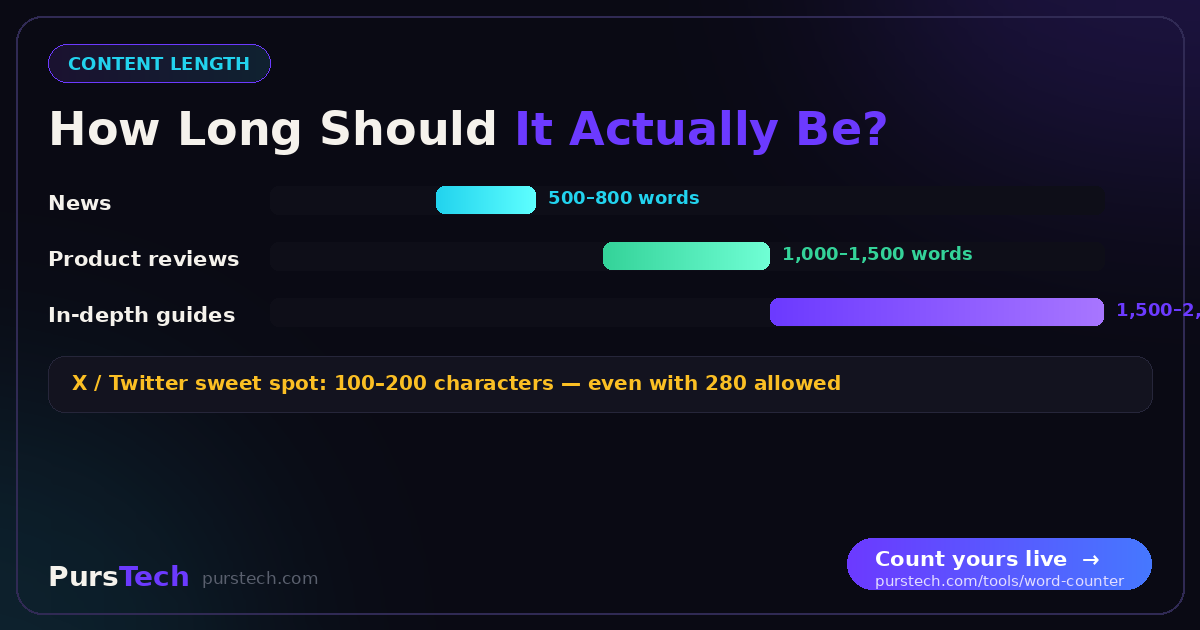
For competitive keywords, long-form content of 1,500 to 2,500 words consistently outperforms shorter pieces in organic search. Google's algorithms correlate length with comprehensiveness. However, Google's Helpful Content system penalizes padded content — a well-researched 1,200-word article will outrank a 3,000-word one filled with filler. Guidelines by type: informational guides at 1,500–2,500 words, news at 500–800 words, product reviews at 1,000–1,500 words.
Social Media Platforms
Twitter/X: Despite the 280-character limit, 100–200 characters gets the highest engagement. Shorter tweets leave room for retweet comments.
LinkedIn: Feed posts truncate at ~210 characters. Your opening must hook the reader. Long-form LinkedIn articles perform best at 1,500–2,000 words.
Instagram: Captions can be 2,200 characters but truncate at 125 in the feed. Posts with 138–150 words drive higher engagement when the opening is compelling.
Facebook: 40 to 80 words drives the highest organic page post engagement.
Email Marketing
Promotional emails perform best at 50–125 words — one offer, one call to action. Newsletter emails work well at 200–500 words. Engagement drops significantly beyond 500 words regardless of content quality.
Meta Tags for SEO
Meta descriptions should be 150–160 characters (25–30 words) — Google truncates longer ones. Meta titles should be 50–60 characters (8–12 words). Titles longer than 60 characters are cut with an ellipsis, potentially hiding your brand name or key terms.
The Reader Experience Rule
Your content should be as long as it needs to fully serve the reader's intent — and no longer. A reader asking "what is a QR code?" needs 200 words. A developer asking "how do I implement OAuth 2.0?" needs 2,000 words. Match depth to need and you will rarely get word count wrong.